Schools
INR 121/-
GST Inclusive
- 1 language per agent
- Certificate included
- Certificate downloadable for 5 years
- Certificate details available for lifetime
- Assessment training
- One attempt allowed
Pricing
All plans are built around one-attempt testing. For custom quotes or commercial negotiation, use the contact page.
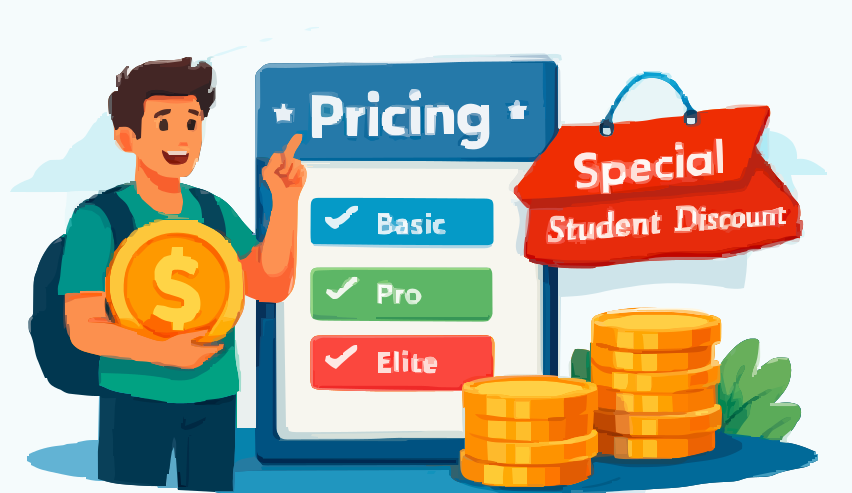
Schools
GST Inclusive
Basic
GST Exclusive @18%
Advance
GST Exclusive @18%
Regional Basic
GST Exclusive @18%
Regional Advanced
GST Exclusive @18%
Get custom quote and negotiation support from our team through the contact page.
Visit contact pagePlan Guidance
Choose the Schools plan when you need fast onboarding, one-language test flow, and certificate verification for academic screening.
Choose Basic or Advance plans for HR and supervisor dashboards, campaign management, and interview-ready language scoring data.
Use Regional Basic or Regional Advanced plans to run regional-language assessments with security controls and audit-ready records.
Pricing Advantages
Assessment budgets usually fail when teams compare only the per-attempt amount and ignore operational drag. A lower ticket price can still become expensive if supervisors spend time recovering failed sessions, if HR cannot trust result quality, or if admins need manual rework after every campaign launch. NativeScore pricing is designed to include the controls that prevent this hidden leakage, including secure attempt flow, role-based reviews, and certificate verification paths that remove repeated back and forth between hiring and operations teams.
The practical advantage is consistency. Pricing becomes a predictable operating envelope where each campaign gets known controls and known review surfaces from day one. When organizations evaluate across quarters, this lowers surprise workload in support, avoids ad hoc patchwork tools, and protects the time of supervisors who should be focused on quality decisions rather than platform firefighting. The result is that budget owners get stable cost per evaluated candidate, not an unstable number that rises with every exception.
Many teams run separate products for test delivery, proctoring, recording storage, report exports, and certificate checks. The invoice lines look manageable in isolation, but integration overhead keeps rising. NativeScore pricing aligns these capabilities in one platform so data flows are already linked: attempt records, role visibility, and certificates remain tied to campaign context. This avoids duplicated storage contracts, duplicate identity handling, and repetitive handoffs between technical and non-technical teams.
The TCO impact is significant in environments with continuous hiring or school batches. A shared base reduces recurring setup work, while plan tiers preserve flexibility for organizations that need only core flow versus advanced control. Finance teams gain a clearer view because spend maps directly to assessment outcomes instead of hidden middleware costs. Over time this improves forecasting and makes expansion approvals easier because operational metrics and commercial metrics are visible in the same frame.
Language assessment demand is rarely flat. Hiring seasons, academic admissions, and certification windows create peaks that can break fragile pricing structures. NativeScore plan architecture is suitable for both steady monthly usage and surge periods because organizations can choose the right tier for governance depth and then scale campaign activity without rebuilding the workflow each time. This prevents emergency procurement cycles and minimizes disruption during high-volume windows when decision speed matters most.
Budget predictability also comes from clearer entitlement boundaries. Teams know which review features, evidence retention behaviors, and oversight views are part of each plan. That clarity reduces internal confusion between admin, supervisor, and HR stakeholders and prevents last-minute escalations such as adding tools mid-cycle. For leadership this means spending decisions become strategic rather than reactive, and assessment programs can be measured on hiring quality, academic readiness, and turnaround time instead of software uncertainty.
Procurement value is realized only when candidates start completing valid attempts quickly. NativeScore pricing supports that outcome by pairing plan selection with operationally ready workflows. Campaign creation, role permissions, section logic, and verification pathways are meant to be configured without long dependency chains. Teams can start pilots, gather evidence, and move to regular operations faster, which shortens the time between subscription decision and measurable assessment output.
Early ROI is especially relevant for institutions and hiring teams under fixed calendars. If onboarding is delayed, every downstream process compresses and quality drops. A pricing model that includes practical setup readiness avoids this compression. Stakeholders can spend effort on exam design, candidate communication, and scoring interpretation rather than tooling adjustments. This is one of the strongest commercial advantages: cost is not only lower in principle, it also starts returning value sooner in practice.
For schools and colleges, affordability must coexist with exam realism. The INR 121 offer model is positioned to help institutions expose students to modern online assessment flow before placement rounds and formal hiring assessments. Instead of delaying practice due to budget concerns, training cells can run structured readiness programs with certificate-backed outcomes. This creates confidence among students while giving faculty and placement teams a measurable baseline for language and typing performance trends.
Commercially this model helps institutions scale participation without creating budget shock. When per-student cost is transparent and aligned with academic planning cycles, administrators can include assessment practice in annual skill development plans. It also supports inclusive access because programs can cover more learners from varied backgrounds. The pricing advantage is not only lower entry cost; it is the ability to run repeat practice cycles that improve job readiness and reduce last-mile anxiety before MNC hiring processes.
Regional hiring and service operations often struggle with tool economics because many platforms are optimized for a narrow language set. NativeScore regional plans are intended to keep multilingual assessment practical by aligning controls, scoring visibility, and certificate verification with campaign-level language requirements. Organizations can evaluate English and regional capabilities in a structured way without maintaining separate systems for each language stream.
The pricing benefit is governance with scalability. Teams can expand into new regional cohorts while preserving one reporting and review model, which lowers process drift and administrative training cost. This is useful for contact centers, distributed support networks, and public service workflows where language coverage is broad. A stable commercial structure encourages long-term planning instead of short-term tactical tests, and that improves hiring quality in language-sensitive operations.
In regulated or high-trust environments, the cost of an invalid assessment can exceed the cost of the assessment itself. Missing evidence, unclear review access, or unverifiable certificates create downstream disputes that consume legal, HR, and operations bandwidth. NativeScore pricing incorporates the platform capabilities required to preserve decision traceability, including attempt intelligence and verifiable certificate flow. This reduces post-assessment uncertainty and protects organizations during escalations.
From a budget perspective, avoiding one major dispute cycle can offset a meaningful portion of annual software spend. More importantly, teams maintain confidence in assessment outcomes and avoid reputational damage caused by inconsistent validation. Pricing should therefore be read as a risk-control investment, not only as a tool subscription. When finance and compliance teams view cost through this lens, the value case becomes much stronger and far more realistic.
Hiring teams lose time when certificate numbers cannot be validated quickly or when records vary across user roles. NativeScore pricing aligns with a unified certificate lifecycle where generated IDs, verification behavior, and downloadable outcomes stay consistent. This reduces friction between recruiters, hiring managers, and external stakeholders who need to confirm candidate performance before progressing to interviews or onboarding decisions.
The commercial upside appears as reduced cycle time and better candidate conversion. When verification is dependable, teams can move from test completion to next-stage communication without manual checks. Candidates also perceive the process as more credible, which improves trust and reduces dropout. Pricing value in this context is measured by operational throughput and decision confidence, both of which directly affect recruitment productivity.
Every organization has different ownership boundaries across admin, supervisor, HR, and campaign operators. NativeScore plan options allow commercial alignment with these boundaries so features are available where they create value and removed where they add noise. This prevents over-provisioning while still preserving the controls needed for valid exam execution and review. In practice, teams spend less time negotiating access after launch because role scope is clearer upfront.
Efficiency gains extend to training and support. When users work with a plan that reflects their actual responsibilities, onboarding materials are shorter and adoption is smoother. Helpdesk teams receive fewer basic access queries and can focus on genuine quality issues. That operational cleanliness lowers internal support cost, making the effective price per managed campaign significantly better than what raw invoice comparisons might suggest.
A common failure mode in assessment procurement is selecting a pilot-friendly plan that cannot evolve into enterprise governance. NativeScore pricing is structured so organizations can begin with a contained deployment, validate outcomes, and then expand into broader campaign footprints with controlled feature progression. This continuity protects previous configuration effort and avoids restarting procurement and implementation from zero.
Strategically this makes growth more manageable for both institutions and companies. Leadership can approve phased expansion based on clear evidence from real usage data, while operations teams preserve a familiar workflow. The combined effect is faster maturity with lower change fatigue. Pricing, in this design, becomes a growth enabler rather than a growth blocker.
Pricing FAQ
Use a full operating-cost lens: onboarding speed, failed-attempt recovery effort, review workload, certificate verification reliability, and support overhead. The best plan is the one with the lowest stable cost per valid decision, not simply the cheapest entry number.
Yes. A phased approach is recommended for many organizations. Start with your immediate requirement, validate campaign outcomes, then upgrade based on volume, governance depth, and reporting needs.
It is designed for school and college readiness programs that need affordable, repeatable practice exposure before placement and hiring assessments.
Regional plans are available so multilingual programs can run with appropriate controls and predictable costs, without forcing separate disconnected tooling.
Plans are aligned to secure test execution, evidence visibility, and verifiable outcomes, reducing downstream dispute management effort and audit follow-up cost.
Yes. For larger deployments and policy-specific workflows, the contact channel can be used for custom commercials and structured rollout planning.
FAQ
The Schools plan is optimized for one-language assessments with certificate issuance and long-term verification.
Yes. Advanced and Regional Advanced plans include screen, camera, and voice recording plus fullscreen enforcement.
Yes. Contact NativeScore for custom commercial structures, volume plans, and deployment support.
Yes. Every plan includes certificate generation and public verification capability.
Yes. Regional Basic and Regional Advanced plans are designed for regional-language test campaigns.
Industry Knowledge Base
Online Assessment Trend
Hiring and education teams are moving from offline screening to digital-first evaluation because recruitment speed, distance learning adoption, and distributed operations demand measurable online outcomes. NativeScore supports this transition by combining writing, listening, reading, speaking, and typing workflows in one environment that is easy to operate but detailed enough for serious decision making. This maps directly to high-intent search behavior where users look for online language assessment platform, secure remote test software, and typing test with certificate for real hiring readiness.
Organizations no longer need only question delivery. They need test integrity, candidate comparability, role-based review paths, and verifiable credentials that can be trusted by external stakeholders. NativeScore addresses these needs through campaign-level controls, progress tracking, and auditable output structure so that assessments are not one-time forms, but process-ready evaluation systems. This helps HR teams, colleges, and training institutes run scalable screening with better confidence and lower process ambiguity.
From a growth perspective, a platform that aligns to real intent queries and workflow outcomes can help institutions attract qualified candidates and partners faster. Clear digital assessment operations reduce failure caused by manual confusion, while structured reporting enables faster decisions in interview pipelines and placement programs.
Special Offer
NativeScore includes a special INR 121 track so schools and colleges can give students meaningful hands-on practice on real online assessment behavior. This offer is designed for institutions that want affordable access without compromising the practical value of the test flow. Instead of only theory training, students can experience timed sections, answer discipline, typing pressure, and result-based performance checkpoints that better reflect modern hiring and training expectations.
For student communities, this special plan is useful because many companies run mandatory online pre-HR tests before interview rounds. Candidates who are academically strong often underperform when they face strict timers, typed response constraints, and language-based filters on unfamiliar digital interfaces. With repeated practice under structured conditions, they build confidence and improve first-attempt outcomes in actual recruitment assessments.
Institutions can also position INR 121 as an employability enablement initiative. Placement cells can conduct periodic readiness drives, identify weaknesses in comprehension and typing speed, and run focused improvement cycles backed by measurable score evidence. This makes student support more practical, data-aware, and outcome-focused.
HR Use Case
NativeScore helps HR and recruitment operations run consistent language screening before manager rounds. Instead of relying only on resume claims and quick telephonic checks, teams can evaluate measurable ability across comprehension, expression, listening interpretation, and typing consistency. This is especially valuable in support operations, sales communication, multilingual service desks, and call center processes where communication quality directly affects customer experience.
A structured pre-HR screen saves interview bandwidth by filtering unprepared candidates early and routing stronger profiles forward with evidence. Recruiters can compare candidates in the same scoring frame and share score snapshots with hiring managers in a clear, process-friendly format. This improves interview quality and reduces cost per qualified shortlist because candidate capability is validated before high-value interview time is consumed.
For organizations managing diverse regions, multilingual screening can be mapped campaign-wise, ensuring each role is evaluated in the required language context. NativeScore supports this operational model without forcing teams to maintain separate disconnected systems for each language path.
Government and Public-Service Style Hiring
Government-facing and public-service style recruitment workflows often require candidates with practical language control in regional contexts. NativeScore can support these requirements through configurable campaign setup and multilingual evaluation paths. Teams can run structured Hindi, English, and regional-language assessments with consistent scoring logic to improve selection quality in large service environments.
Third-party assessment support becomes important when hiring volume is high and fairness expectations are strict. NativeScore contributes by providing transparent process structure, campaign governance controls, and verifiable certificate outputs that can be validated independently. This combination helps build trust in screening quality while reducing dependence on manual evaluation variability.
Where call center and citizen-support processes need regional fluency, NativeScore can be used to benchmark candidate readiness before onboarding. This protects service quality and ensures language fit is validated in measurable terms rather than assumed from self-declaration.
Case Study
In a common placement scenario, students completed college with strong academic performance but limited familiarity with online screening tools used by large employers. Many faced typing tests and communication assessments before HR rounds and were eliminated due to interface pressure, timing stress, and low confidence rather than lack of potential. NativeScore was adopted as a practical readiness layer to bridge this gap.
The placement team ran repeat mock cycles with targeted feedback for typing speed, reading focus, listening retention, and response quality. Because each attempt produced structured score data, mentors could coach students with evidence instead of generic advice. Over multiple cycles, candidates reported stronger comfort with timed exam conditions and better execution in employer-facing online rounds.
This case pattern shows why practical digital exposure matters for freshers. NativeScore transforms readiness from one workshop to a measurable progression system, helping institutions reduce avoidable failure in pre-HR screening pipelines and improve candidate confidence during campus hiring seasons.
Distance Learning
Distance learning and hybrid programs have made digital assessment behavior a foundational skill. Students now need to operate confidently in secure online environments, complete timed tasks, and submit high-quality responses without classroom dependency. NativeScore helps institutions train this behavior through realistic practice campaigns that mirror modern exam and hiring conditions.
Colleges can integrate assessments into placement readiness calendars, language labs, and employability modules so students gain repeated familiarity with real platform workflows. This includes typing discipline, comprehension under time constraints, and response quality tracking. The result is not only score improvement but also reduced anxiety when students face mandatory online tests from recruiters and corporate hiring partners.
For schools, early exposure to guided digital assessments creates long-term benefits in confidence, self-evaluation, and communication skill development. Institutions can use this model to support both academic progression and future workforce preparedness.
Typing Assessment Need
Many large employers include typing and online language screens before HR conversations, especially in roles that require real-time communication, ticket handling, and service documentation. NativeScore aligns with this hiring reality by offering practical typing and language capability checks that can be repeated for improvement and benchmarked for eligibility decisions.
Students and candidates often underestimate typing as a selection criterion until they encounter actual screening rounds. With NativeScore, institutions and training partners can build targeted preparation programs where participants practice speed, accuracy, and comprehension together, not in isolation. This integrated approach is more aligned with real recruitment tools than standalone typing games.
When typing outcomes are tied to broader language assessments, organizations get a stronger capability picture. Recruiters can identify candidates who not only type fast but also understand instructions, process input correctly, and respond in role-relevant language standards.
Supervisor and Admin Intelligence
NativeScore gives operational stakeholders practical control through role-based dashboards. Admin users can configure campaigns, supervisors can review attempt intelligence, and HR teams can evaluate candidate outcomes based on authorized scope. This design supports accountability in environments where multiple teams participate in screening decisions.
Visibility is especially important when organizations run multilingual or high-volume assessments. Decision makers need a clear view of status, progress, and quality indicators without navigating disconnected systems. NativeScore centralizes this workflow so review efficiency improves while process integrity remains intact.
For institutions and enterprises, this governance model supports repeatable execution. Teams can standardize workflows, reduce operational confusion, and maintain quality as assessment scale increases across departments or campuses.
Certificate Trust
Certification is valuable only when it can be trusted by third parties. NativeScore includes certificate generation with public verification so employers, institutions, and partners can validate credential authenticity using a unique ID. This supports credibility in hiring and learning ecosystems where proof of skill must be checked quickly and reliably.
Public verification also helps candidates because they can share credentials with confidence across opportunities without repeated manual explanations. Recruiters and reviewers can validate results independently and proceed with decision workflows faster. This reduces friction between candidate achievement and employer trust.
In long-term operations, certificate verification becomes a durable quality signal for the platform itself. It demonstrates process transparency and improves confidence in assessment outcomes beyond the moment of test completion.
Multilingual Capability
Language readiness varies by role and geography. NativeScore supports multilingual configuration so campaigns can evaluate candidates in Hindi, English, and regional languages according to job context. This flexibility is critical for organizations hiring across markets where language fit directly influences service performance.
Regional language assessment is increasingly important in customer support and distributed service processes. NativeScore helps organizations validate communication quality before onboarding, reducing downstream service risk and training overhead. Institutions can also use this model to prepare students for region-specific opportunities with better confidence.
Running all language paths in one framework improves governance and reporting consistency. Teams avoid fragmented tools and maintain a standard process for scoring, review, and certificate validation across language tracks.
Implementation Roadmap
Most successful deployments follow a phased model: start with one campaign, validate score reliability, train operational users, and scale based on outcome confidence. NativeScore supports this progression through campaign-level controls that can be expanded without redesigning the entire workflow. This lowers implementation risk and accelerates adoption.
During pilot phase, teams can focus on one high-impact use case such as pre-HR language screening or placement typing readiness. Once baseline effectiveness is proven, additional role tracks, language paths, and review policies can be introduced in a controlled manner. This keeps expansion predictable and measurable.
A phased roadmap is also budget-friendly because organizations can align license growth with demonstrated value. NativeScore can therefore support both early-stage adoption and enterprise-scale expansion while maintaining process continuity.
Custom Tooling by License Size
When candidate volume grows, organizations often need custom workflow behavior: role-specific campaign paths, reporting depth changes, governance rules, and specialized process alignment. NativeScore can support requirement-based configuration linked to license scale so customers can move beyond generic setups and operate with better strategic fit.
This model is useful for large campus networks, enterprise hiring programs, and multilingual service operations where one-template logic is not enough. By mapping configuration to license and process size, NativeScore enables practical customization without losing platform consistency.
Custom tooling can include content strategy alignment, review queues, certificate governance, and language-specific deployment controls. The result is a scalable assessment system designed around real operational outcomes rather than isolated test execution.